Palate by Design × EKAA — Designing the Table as a Spatial Idea
Some collaborations don’t begin with a brief. They begin with a question.
What does a meal want to feel like—before it wants to look like anything?
Palate by Design was never meant to be “an event setup.” It was a live design exercise—where food, light, material, and tempo had to align. When you work with a chef like EKAA, you’re not styling plates. You’re composing an experience with a very precise emotional arc: anticipation, surprise, comfort, aftertaste. My job was to translate that arc into space.
Our first conversations weren’t about décor. They were about rhythm.
How do guests arrive? Do they pause? Do they move? Where does attention land—on the table, on the hands, on the smoke, on the sound of cutlery? You can’t design a dining experience if you don’t understand its choreography.
We mapped the evening like a sequence of scenes.
A calm threshold. A moment of focus. A release. Then softness again.
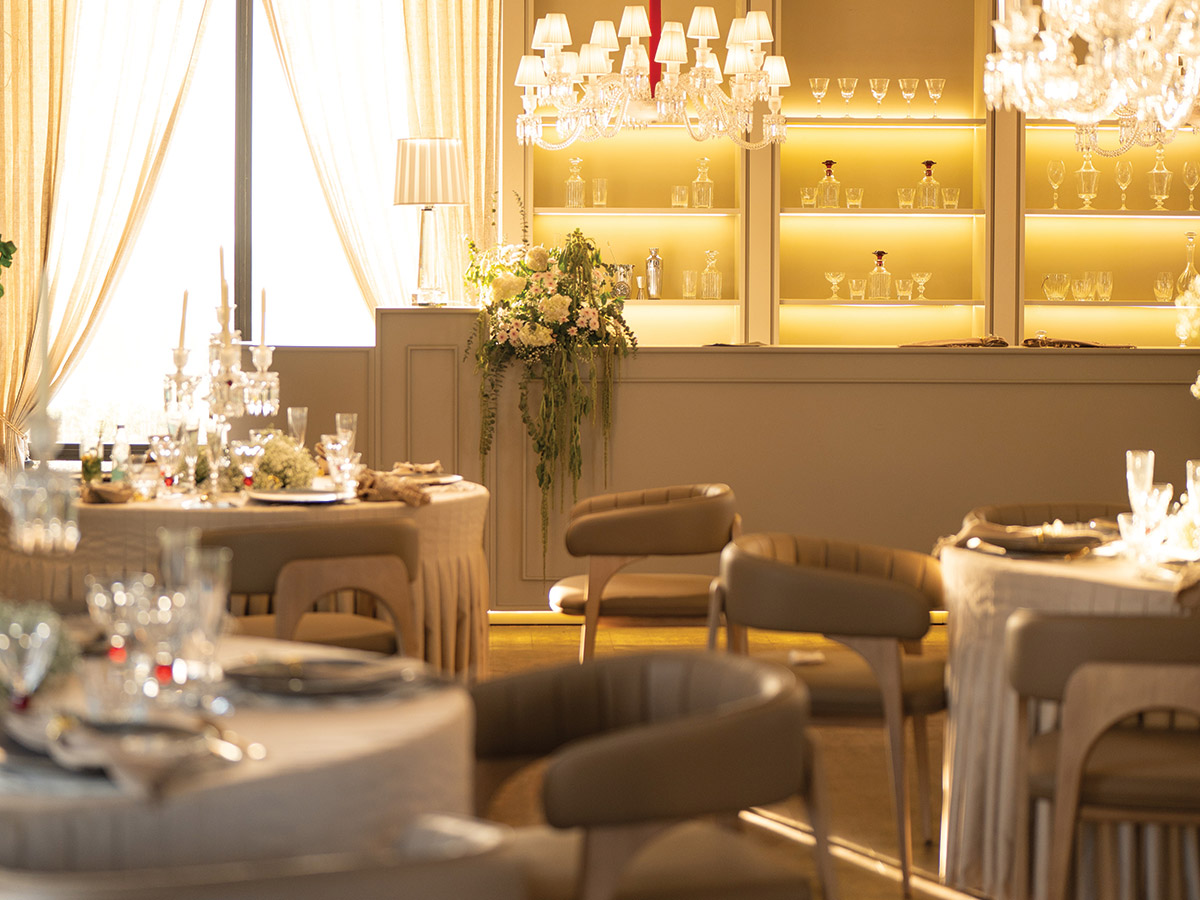
The key decision was restraint. Not minimalism as an aesthetic—restraint as a strategy. Food has its own color, texture, and drama. If the space competes, the story fractures. So the palette was kept quiet, the surfaces honest, the lighting warm but disciplined. We built a background that could hold detail without shouting.
Then came the tactile layer—because dining is not visual alone.
We thought through what the hand meets: the edge of the table, the weight of a napkin, the temperature of a surface, the distance between settings. Hospitality, at its best, is micro-geometry. One inch too tight and it feels crowded. One inch too wide and it feels performative. We calibrated spacing so conversations could bloom without needing to raise voices.
Lighting was treated like a seasoning.
Not “bright enough.” Not “mood lighting.” Instead: directional clarity with pockets of intimacy. Faces should be readable. Food should be honored. The room should feel like it’s holding you—not observing you. We avoided harsh overhead glare and designed a softer fall of light that kept the table as the protagonist.
We also paid attention to silence—what I call visual silence.
Every element on the table has to earn its place. If everything is special, nothing is special. So we edited. We simplified. We let negative space do the work. That emptiness is not emptiness—it’s a frame. It’s how you make room for presence.
During the event, what stayed with me most was how quickly people slowed down.
Not because we asked them to. Because the environment subtly gave them permission. The moment the first course arrived, you could feel the room shift: less phone, more eye contact, more listening. That’s the real benchmark. Not whether the setup photographed well—but whether it changed behavior.
Palate by Design, for me, is proof that interiors can be more than beautiful. They can be precise. They can choreograph emotion. They can make a meal feel like a memory while it’s still happening.
And that’s what I love about this intersection of food and design:
Both are ephemeral. Both disappear. And yet, if done with care, both leave a trace.